
ABDOMINAL WALL SURGERY
Inguinal Hernia
A common abdominal wall condition that may require surgical treatment when it becomes symptomatic or when the situation warrants it.
An inguinal hernia occurs when part of the abdominal contents protrudes through a weakness in the groin area.
It may present as a bulge in the groin, discomfort or pain, particularly during exertion. A consultation confirms the diagnosis and determines the most suitable management.
What is an inguinal hernia?
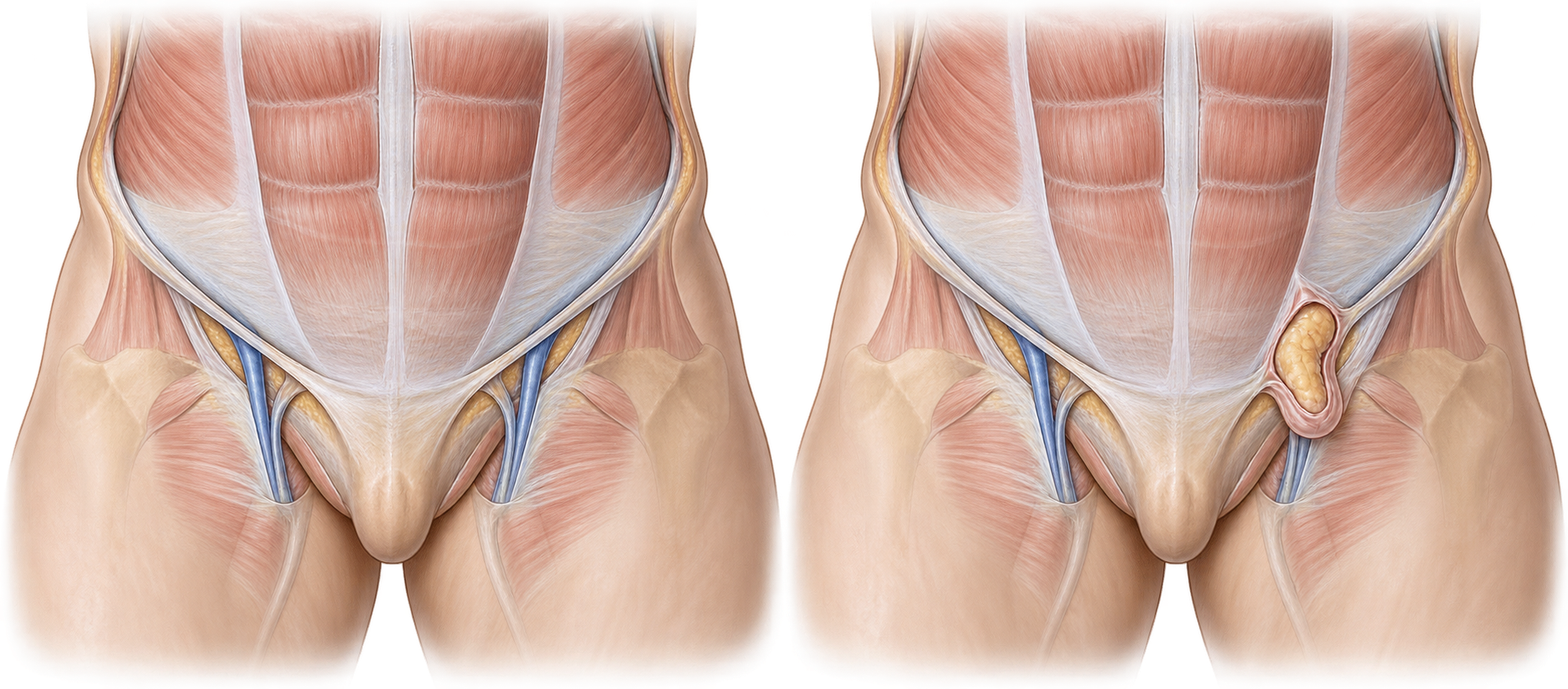
An inguinal hernia is the passage of part of the abdominal contents through a weakness in the abdominal wall located in the groin.
This protrusion forms a hernia sac, which may contain abdominal fat or part of the intestine.
The hernia can become visible as a bulge in the groin. It may appear or increase in size when abdominal pressure rises, for example when standing, during exertion, or when coughing.
In some patients it remains only mildly bothersome. In others, it progressively causes a feeling of discomfort, heaviness, or pain.
What are the symptoms of an inguinal hernia?
The way an inguinal hernia presents varies from person to person. Some are easily visible, while others mainly cause discomfort or pain.

A bulge in the groin
A bulge may appear in the groin area, sometimes more visible when standing or during exertion.
Discomfort or heaviness
A feeling of tension, pressure, or heaviness may be felt in the groin.

Pain with exertion
Discomfort may appear or increase with certain efforts, coughing, or lifting.
Sometimes few symptoms
Some hernias cause little or no symptoms and are discovered during a medical examination.
How is an inguinal hernia diagnosed?
Clinical examination is usually essential
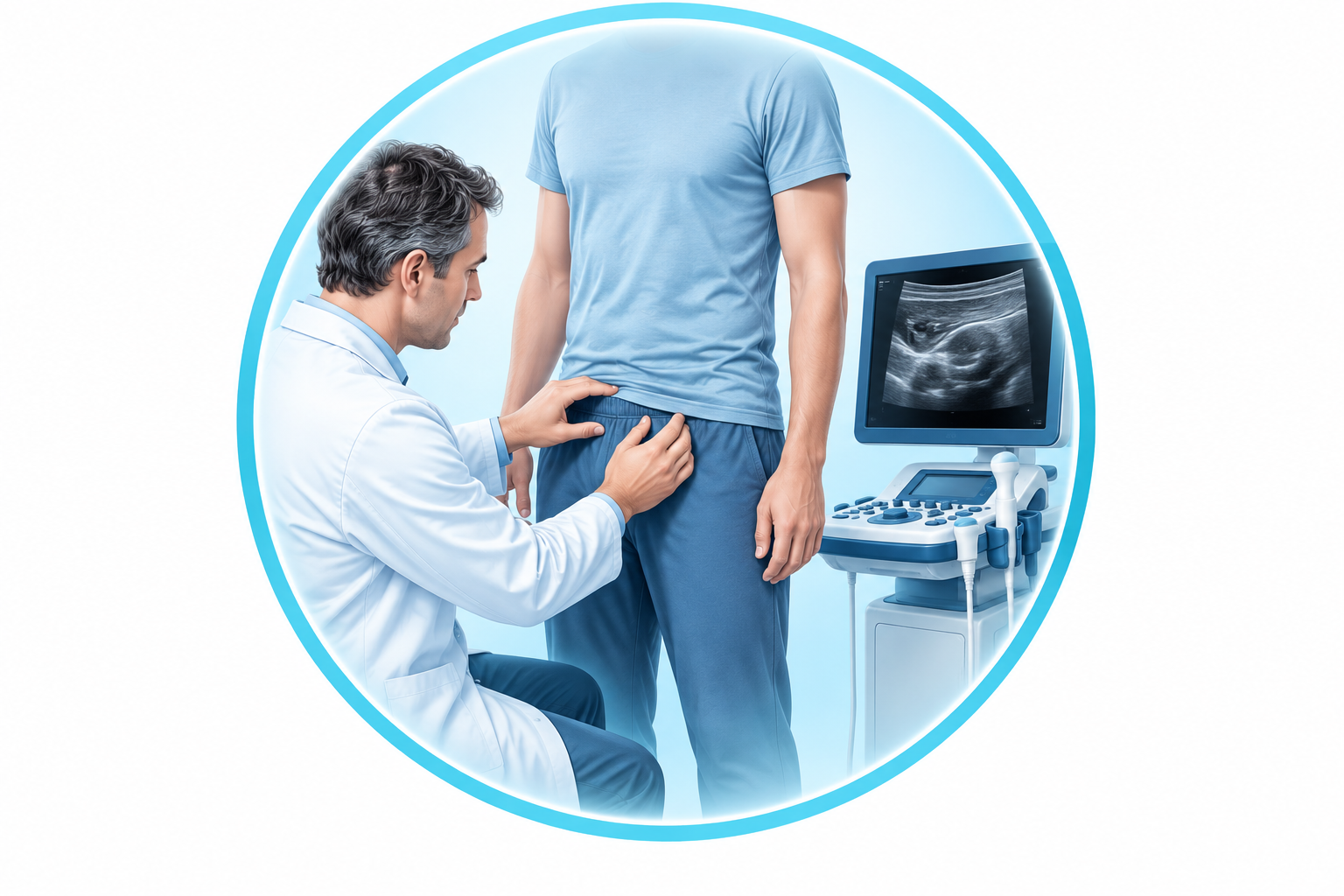
The diagnosis mainly relies on the symptoms described by the patient and on the clinical examination.
The surgeon examines the groin area to look for a swelling consistent with a hernia and to assess its characteristics.
In most typical situations, the clinical examination is enough to establish the diagnosis. When it remains uncertain, an ultrasound, or more rarely another imaging test, may be useful.
Not all groin pain is caused by a hernia. The medical evaluation also looks for other causes when necessary.
Should an inguinal hernia always be operated on?
The decision depends on symptoms and individual circumstances
An established inguinal hernia usually does not disappear on its own. This does not mean, however, that every hernia must be operated on immediately.
In some men with an asymptomatic or mildly symptomatic inguinal hernia, watchful waiting may be discussed, as the risk of a hernia-related emergency is low. A significant proportion of these patients will nonetheless be operated on later, notably due to the onset or worsening of symptoms.
Surgery is generally discussed when the hernia causes symptoms or when the clinical situation warrants repair.
The decision takes into account symptoms, the characteristics of the hernia, overall health, the patient’s activities, and their preferences.
Watchful waiting
Possible in certain selected situations when the hernia is asymptomatic or mildly symptomatic.
Surgical treatment
Repairs the weakened area of the abdominal wall when surgery is indicated.
The goal is not to systematically operate on every inguinal hernia, but to offer a strategy adapted to each situation.
When does a hernia become an emergency?
Certain symptoms require prompt evaluation
A hernia can sometimes become suddenly painful and can no longer be pushed back. This situation requires prompt medical evaluation, particularly because of the risk to the hernia’s contents.
An acute, irreducible hernia may constitute a surgical emergency, particularly when strangulation is suspected.
Seek prompt care if you notice:
- sudden or severe pain at the hernia site;
- the hernia has become hard, very tender, or cannot be pushed back;
- a sudden increase in size;
- associated nausea or vomiting;
- a general deterioration in condition.
How is an inguinal hernia treated?
Surgery aims to repair and reinforce the wall
When surgery is indicated, its goal is to reposition the hernia’s contents and repair the weakened area of the abdominal wall.
For most operated patients, international guidelines recommend a mesh-reinforced repair, often called a mesh repair. This approach reduces the risk of recurrence without increasing the risk of chronic pain compared to non-mesh repairs.
Non-mesh repairs may nonetheless be offered in certain selected situations, after discussion with the patient and when appropriate expertise is available.
Several surgical approaches can be used. The choice depends notably on the hernia, the patient’s history, and the surgical strategy chosen.
What surgical techniques are available?
Open surgery
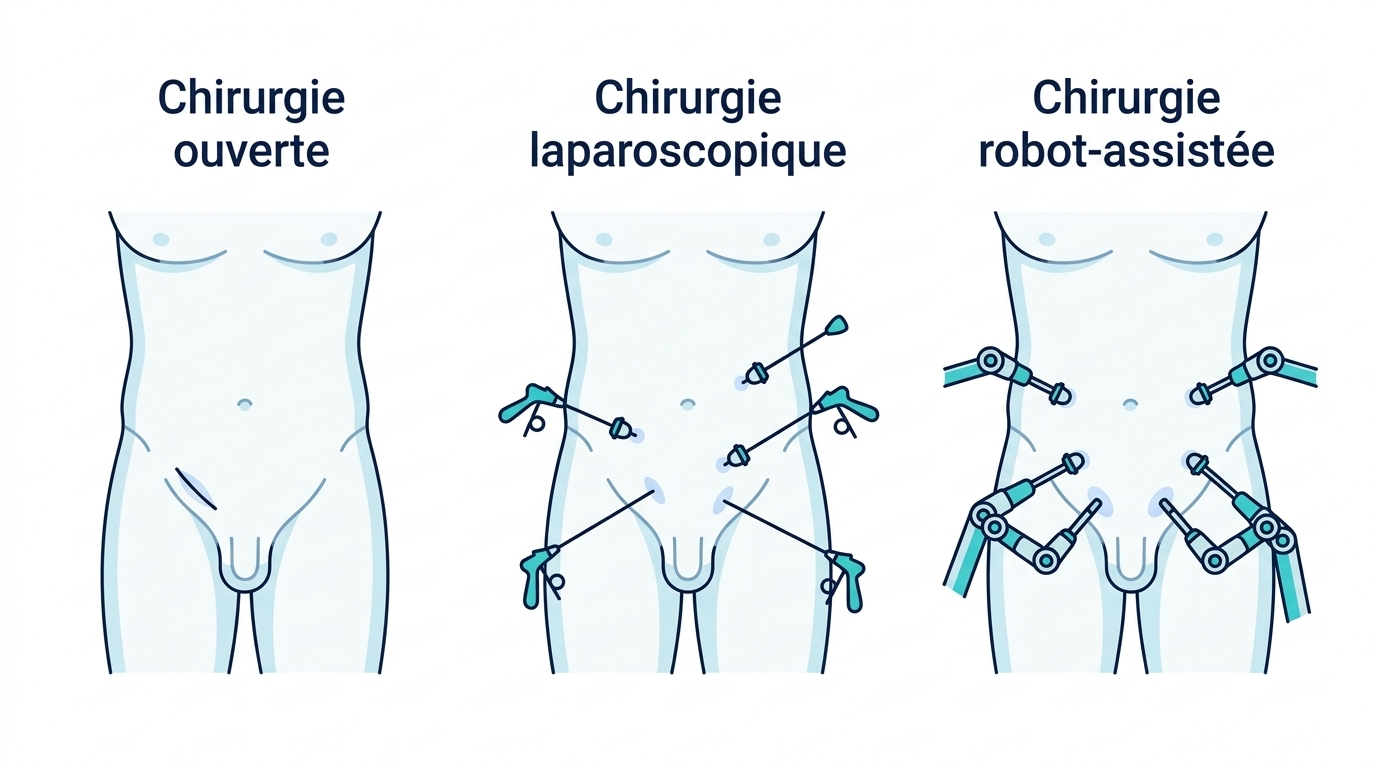
The procedure is performed through an incision in the groin. The weakened area is repaired and, in most cases, reinforced with a mesh. The Lichtenstein technique is one of the best-studied open repairs; other open techniques, including preperitoneal ones, may also be used.
Laparoscopic surgery
Repairs the hernia through small abdominal incisions. The TEP and TAPP techniques approach the groin from behind and place a mesh in a preperitoneal plane, often with faster recovery and less chronic pain than open Lichtenstein repair in appropriate situations.
Robotic surgery
Robot-assisted surgery is another minimally invasive approach. The surgeon operates from a console, continuously controlling articulated instruments through small incisions, with three-dimensional vision and great precision. The robot never operates autonomously.
Which technique should be chosen?
A strategy adapted to each patient
There is no single technique suitable for all inguinal hernias.
The choice between open surgery and a minimally invasive approach, as well as the choice of minimally invasive technique when indicated, depends notably on:
- the type and size of the hernia;
- whether one or both sides are affected;
- a possible recurrence;
- previous abdominal surgery;
- overall health;
- anatomy;
- surgical expertise.
International guidelines emphasize an individualized approach that takes into account the patient’s characteristics, the hernia, the surgeon’s expertise, and available resources.
The choice of technique is discussed during the consultation in order to offer the approach best suited to the individual situation.
What does the pathway look like?
- Consultation — clinical examination, confirmation of the diagnosis, and assessment of symptoms.
- Treatment choice — discussion between watchful waiting and surgery when indicated.
- Technique choice — determining the surgical approach suited to the situation.
- Surgery and recovery — repair of the hernia followed by a gradual return to activity.
- Follow-up — monitoring of healing, symptoms, and recovery.
What are the risks of surgery?
Like any surgical procedure, inguinal hernia repair carries risks. These vary according to the patient’s situation and the technique used.
A hematoma may appear in the operated area and usually resolves gradually on its own.
A temporary fluid collection may occur in the operated area.
A wound infection may occur. Infection involving a mesh is rarer.
Groin discomfort or pain may persist after surgery. Preventing and managing chronic pain is an important aspect of hernia surgery.
A hernia can recur after repair, even though current techniques aim to limit this risk.
Other, rarer complications are possible and depend notably on the technique used and the individual situation.
Benefits, risks, and alternatives are discussed individually before surgery.
After surgery
A gradual return to activity
Recovery depends on the surgical technique, the characteristics of the hernia, professional activity, and individual progress.
Mobilization is generally encouraged after surgery. International guidelines recommend a return to normal activities based on comfort rather than systematic prolonged restrictions.
Instructions regarding sport, lifting, driving, and returning to work are tailored to each patient.
Mobilization
Gradual return to walking and daily activities.
Pain
Pain relief adapted to the postoperative period.
Physical activity
Gradual resumption based on comfort and the instructions given.
Follow-up
Monitoring of healing and postoperative progress.
Personalized care
Care tailored to your hernia
Not every inguinal hernia requires the same strategy.
The consultation confirms the diagnosis, assesses the symptoms and characteristics of the hernia, and then discusses the different treatment options.
When surgery is indicated, the choice of technique is tailored to the individual situation.
Dr Pierre Fournier
General and visceral surgery
[Photo of Dr Fournier — to be added once available]
Frequently asked questions
An established inguinal hernia generally does not close on its own. This does not mean, however, that immediate surgery is necessary in every situation.
No. Watchful waiting may be discussed for some men with an asymptomatic or mildly symptomatic hernia. The decision depends on the individual situation.
Groin pain can have different causes. Clinical examination usually helps identify a hernia and determine whether further tests are needed.
Yes, in certain situations. A hernia that suddenly becomes painful and irreducible requires prompt evaluation.
A mesh repair is recommended for most operated patients. Non-mesh repairs may still be considered for certain selected patients.
These are two minimally invasive techniques that both achieve a preperitoneal repair. They mainly differ in the route used to access this space.
Yes, some inguinal hernia repairs can be performed with robot-assisted surgery. The choice of this approach depends on the individual situation and the surgical strategy chosen.
No. The robot does not perform the procedure autonomously. The surgeon controls the instruments from a console throughout the entire operation.
When a hernia is present on both sides, bilateral repair may be considered. The choice of approach depends on the clinical situation.
This depends notably on the surgery performed, the type of professional or sporting activity, and postoperative progress. Instructions are tailored individually.
Think you may have an inguinal hernia?
A bulge, discomfort, or persistent pain in the groin may warrant a surgical evaluation.
The consultation confirms the diagnosis, assesses the hernia, and determines whether watchful waiting or surgical treatment is indicated.