
BARIATRIC AND METABOLIC SURGERY
Adjustable Gastric Band
A restrictive, adjustable technique with no change to the intestinal tract.
The adjustable gastric band is placed around the upper part of the stomach to limit food intake and promote earlier satiety.
Unlike sleeve gastrectomy, no part of the stomach is removed. Unlike gastric bypass, the intestine is not bypassed.
Its use is now more limited and must be discussed individually, taking into account the benefits, constraints, and long-term results.
What is an adjustable gastric band?
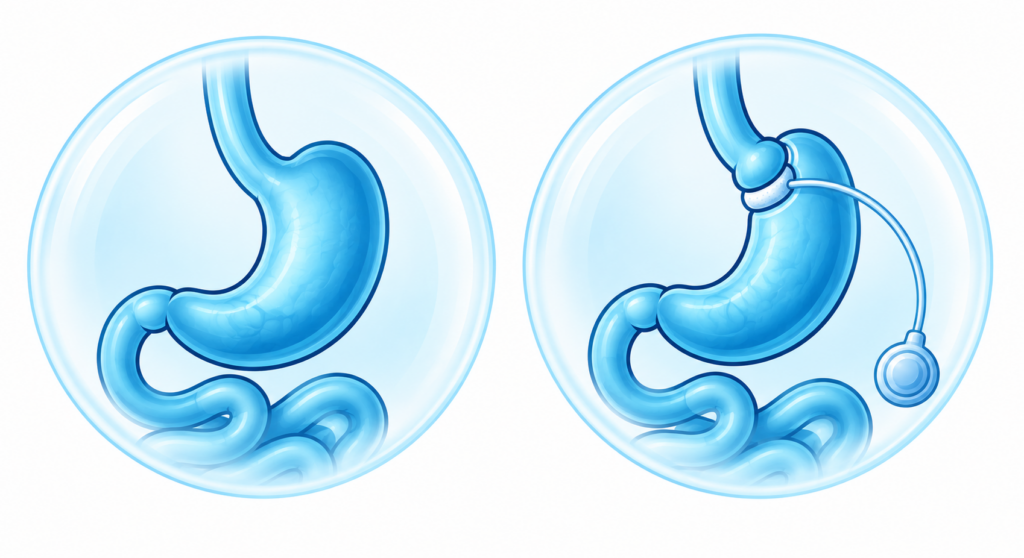
The gastric band is a device placed around the upper part of the stomach. It creates a small gastric pouch above the band and slows the passage of food into the rest of the stomach.
The band is connected by a tube to a small port placed under the skin. Adding or removing fluid from this port allows the diameter of the band to be gradually adjusted.
The stomach is neither cut nor removed, and the intestinal tract remains intact.
Normal digestive anatomy
Adjustable Gastric Band
How does the gastric band work?

Reduced food quantities
The narrowing created by the band limits food intake and encourages smaller portions.

An adjustable band
The diameter of the band can be adjusted during follow-up by injecting or removing fluid through the port placed under the skin.

A preserved digestive tract
Food continues its natural path through the stomach and then into the duodenum and intestine. There is no intestinal bypass.
Who can be offered a gastric band?
A now more limited indication
The gastric band is one of the bariatric surgery techniques, but its use has decreased significantly in recent years.
Weight loss is generally slower and less significant than with other procedures, and the band carries specific risks of complications that may lead to a further operation or its removal.
The choice of a gastric band should therefore be the subject of an individualized discussion after a complete work-up and a presentation of the different alternatives.
In Switzerland, this is part of specialized care that meets the criteria defined by the Swiss Multidisciplinary Obesity Society (SMOB).
How does the pathway work?
The gastric band is one step in a care pathway

Evaluation
Medical and nutritional work-up, screening for associated conditions, and assessment of the individual situation.
Preparation
Information about the procedure, nutritional preparation, and organization of postoperative follow-up.
Procedure
The gastric band is placed under general anesthesia, laparoscopically whenever conditions allow.
Adjustment
Postoperative monitoring and gradual resumption of eating according to the multidisciplinary team’s protocol.
Follow-up
Regular long-term medical, nutritional, and biological check-ups, including with your primary care physician.
Benefits and limitations
Characteristics of the band
The procedure requires neither removal of part of the stomach nor an intestinal bypass. The device can be adjusted and can also be removed if necessary. The risk of deficiencies directly related to malabsorption is low.

Significant limitations
Weight loss is generally slower and less significant than after a sleeve or bypass. The band requires adjustments and regular monitoring. In the long term, device-related complications may require a further operation.

What are the risks of the adjustable gastric band?
Like any surgical procedure, the gastric band carries early and late risks.
The band can shift and change the shape of the gastric pouch, which can cause difficulty eating, regurgitation, or vomiting.
More rarely, the band can gradually erode the stomach wall and require removal.
A band that is too tight, or certain functional disorders, can cause discomfort when eating, regurgitation, or vomiting.
Dilation may appear in the long term and require adjustment of the band or specific management.
The port, tube, or band itself may develop mechanical or infectious complications sometimes requiring a procedure.
In the long term, certain complications or an insufficient result may lead to removal of the band or discussion of another bariatric procedure.
This list is not exhaustive. Individual benefits and risks are discussed during the consultation and the preoperative work-up.
Regular follow-up is essential
Follow-up allows the tightness of the band to be adjusted, food tolerance and weight evolution to be assessed, and any device-related complications to be identified.
Adjustments are made by adding or removing fluid through the port placed under the skin.
Medical Follow-up
Band Adjustment
Vitamin Supplementation
Dietary Follow-up
Psychological Follow-up
Physical Activity Follow-up
Band, sleeve, or bypass
Very different techniques
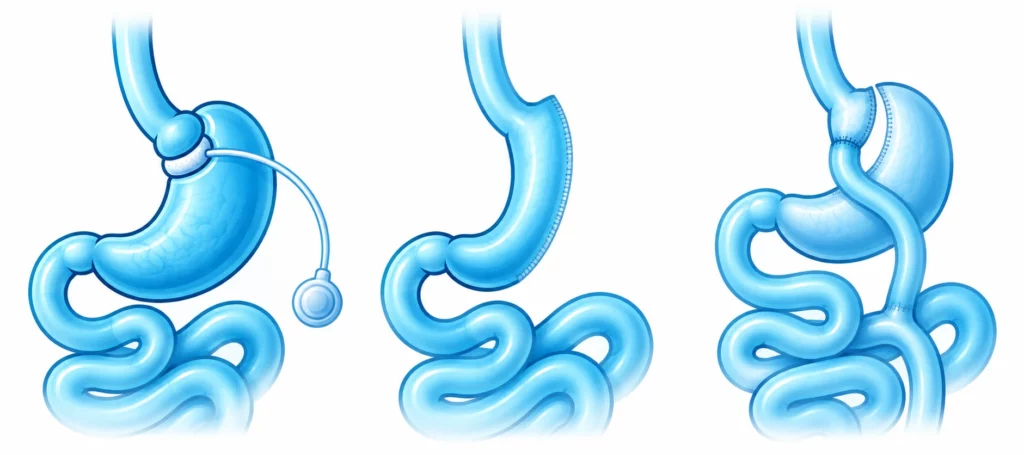
Gastric band
The stomach and intestine are not cut. An adjustable device limits food intake.
Sleeve gastrectomy
A large portion of the stomach is removed to create a tubular stomach.
Gastric bypass
A small gastric pouch is created and connected to the intestine, changing the path of food.
The choice depends on many factors: medical situation, history, eating behavior, associated conditions, reflux, treatments, and patient preferences.
The decision is made after a complete work-up and discussion with the patient as part of multidisciplinary care.
It is not about choosing the “most effective” operation in absolute terms, but the one best suited to the patient’s situation.
Frequently asked questions:
Yes, but its use is now much more limited. Other procedures are performed more frequently, particularly because of their weight-loss and metabolic outcomes.
The device can be removed. However, this does not mean that the stomach or digestive system will necessarily return exactly to their previous functional state after several years.
The diameter of the band is adjusted by adding or removing fluid through a port placed under the skin.
Yes. Weight outcomes vary from patient to patient, and weight regain or insufficient loss can occur in the long term.
In certain situations, removal of the band may be followed by, or associated with, a discussion of another bariatric procedure. The strategy depends on the individual anatomical and medical situation.
Considering obesity surgery?
Every situation is different. The consultation allows your history, health status, and expectations to be assessed, and the different treatment options to be discussed.
The goal is to determine, together with you, the strategy best suited to your situation.