
ABDOMINAL WALL SURGERY
Incisional Hernia
A hernia that develops at a previous surgical scar, treated with a strategy tailored to each situation.
An incisional hernia occurs when the musculo-aponeurotic layer progressively separates at the site of a previous abdominal surgery scar.
Diagnosis, abdominal wall preparation, and selection of the most suitable repair technique, including for complex situations.
What is an incisional hernia?
An incisional hernia occurs when a hernia forms at the site of a previous abdominal surgery scar, due to progressive separation of the musculo-aponeurotic layer that was closed during the initial operation.
It differs from a so-called “primary” hernia (umbilical or inguinal, for example), which occurs without any prior surgery in the area concerned.
This is a frequent situation: it can occur after any open abdominal surgery, with a variable frequency depending on the type of procedure and individual risk factors.
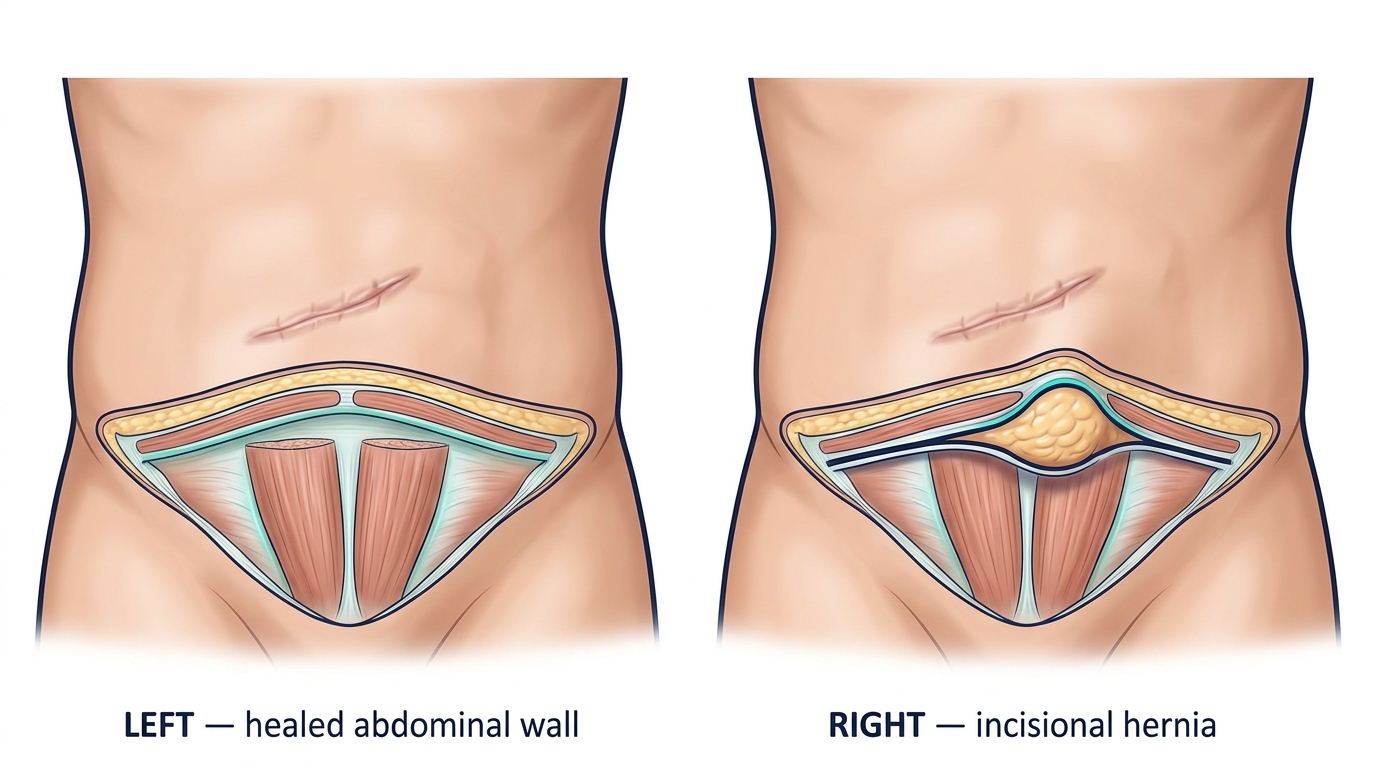
Why does an incisional hernia form?
An incisional hernia is not a patient’s failure: it most often results from a combination of several factors, some of which can be improved before a further operation.
- a surgical site infection following the initial operation;
- overweight or obesity, which increases the tension on the abdominal wall;
- smoking, which impairs wound healing;
- poorly controlled diabetes or long-term corticosteroid therapy;
- chronic coughing or straining too soon after the operation;
- the abdominal wall closure technique used during the initial operation.
What are the symptoms of an incisional hernia?
Symptoms vary depending on the size and location of the hernia.
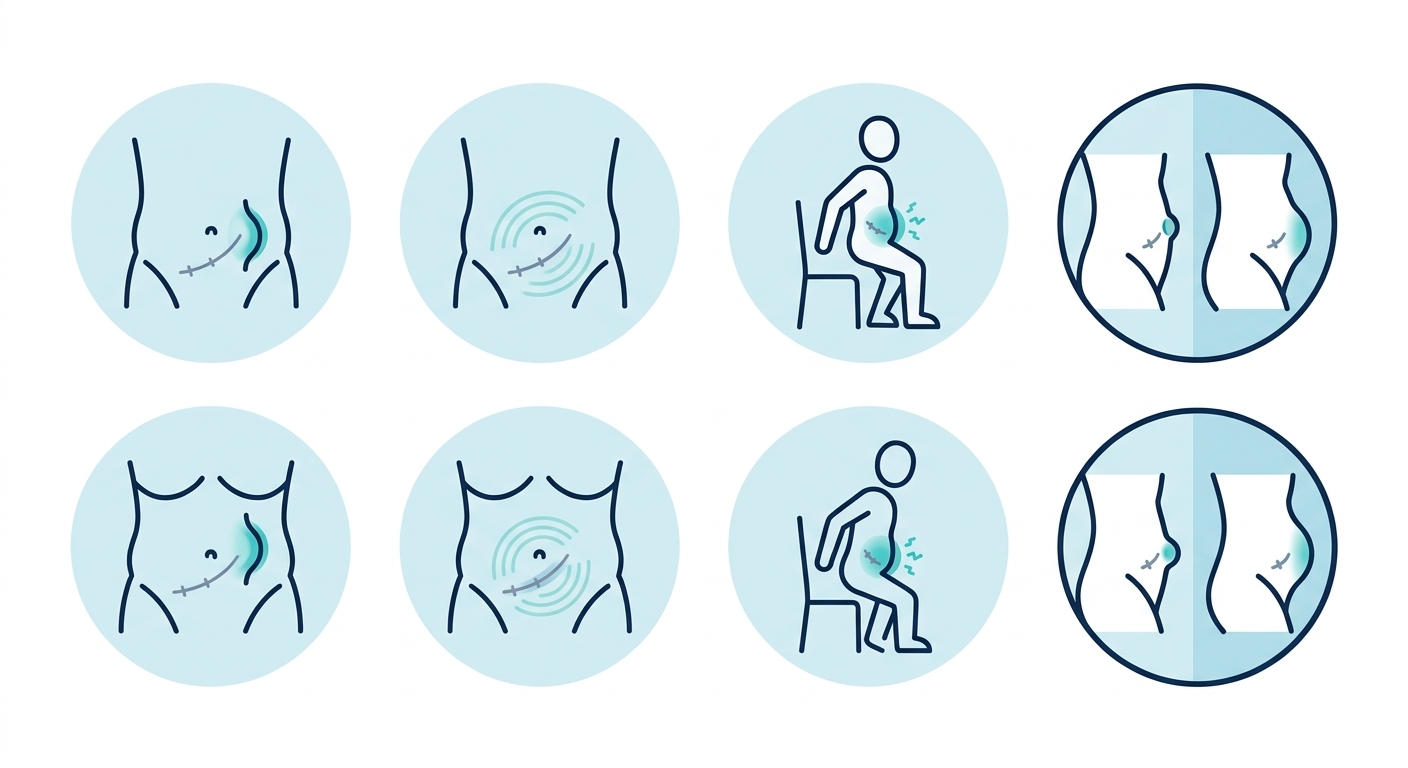
A bulge at the scar
A visible swelling appears at a previous surgical scar, sometimes reducible.
Discomfort or pain
Pain or discomfort may appear with exertion or prolonged standing.
An impact on the abdominal wall
A sensation of weakness or functional discomfort may develop gradually.
Sometimes asymptomatic
Some incisional hernias are discovered during a clinical examination or imaging.
How is the diagnosis made?
Clinical examination (inspection and palpation, standing and lying down, coughing or straining maneuvers) is most often sufficient to confirm the diagnosis.
An abdominal CT scan is frequently performed in addition: it specifies the size of the defect and the content of the hernia, and allows the repair to be planned, particularly for large or complex incisional hernias.
Does it always need to be operated on?
Monitoring
For small, asymptomatic incisional hernias, particularly in a frail patient, regular clinical follow-up may be proposed.
Surgical treatment
Recommended in cases of symptomatic, large, or complication-prone incisional hernia.
When does an incisional hernia become an emergency?
Certain signs require prompt evaluation
An incisional hernia can be complicated by strangulation, when the herniated contents can no longer be reduced and their blood supply is compromised. This is a surgical emergency.
Seek care promptly if you experience:
- sudden, intense pain over the bulge;
- a bulge that has become hard and irreducible;
- nausea or vomiting;
- inability to pass gas or stool;
- associated fever.
Preparing the abdominal wall before surgery
For large incisional hernias in particular, optimizing overall health before repair improves the chances of success and reduces the risk of recurrence:
- weight loss in cases of obesity;
- smoking cessation;
- better control of diabetes;
- nutritional optimization.
When significant weight loss is needed before a complex abdominal wall repair, care through bariatric and metabolic surgery may be proposed beforehand.
Principles of surgical treatment
Repair relies on reinforcing the abdominal wall with a prosthetic mesh, which distributes tension and reduces the risk of recurrence compared to simple direct suture.
The choice of surgical approach and the plane in which the mesh is placed depends on the size of the defect, its location, and the patient’s overall condition.
Which surgical techniques?
According to the recommendations of hernia surgery societies, open, laparoscopic, or robot-assisted surgery may all be appropriate depending on the patient, the hernia, and the surgeon’s expertise: there is no single technique that is superior in all circumstances.
Open surgery
Preferred for large or complex incisional hernias.
Laparoscopic surgery
Suited to medium-sized incisional hernias, with the usual benefits of minimally invasive surgery.
Robot-assisted surgery
Precision in dissection and suturing, particularly suited to abdominal wall repositioning.
Retromuscular mesh placement
One of the reference techniques involves positioning the mesh in the retromuscular plane, behind the rectus abdominis muscles.
This placement, without direct contact with the abdominal organs, promotes good integration of the mesh into the abdominal wall and limits the risk of adhesions with the digestive contents.
Which technique to choose?
Several factors guide the choice of surgical strategy:
- the size of the abdominal wall defect;
- its location;
- the number of previous operations;
- the possible presence of mesh already in place;
- the patient’s overall condition (weight, smoking, comorbidities);
- the surgeon’s experience and preference.
Complex incisional hernias
Large incisional hernias, loss of abdominal wall substance, or multiple recurrences require specific planning.
Preliminary abdominal wall preparation is then particularly important, and may include, depending on the case, a preoperative injection of botulinum toxin to relax the abdominal wall and facilitate its closure.
How does the pathway work?
- Consultation and work-up — clinical examination and imaging if needed.
- Abdominal wall preparation — optimizing weight, smoking, and overall condition if needed.
- Surgical procedure — repair of the abdominal wall using the chosen technique.
- Immediate postoperative follow-up — monitoring of healing.
- Gradual resumption — of activities and follow-up review.
What are the risks?
Like any surgical procedure, incisional hernia repair carries risks, which are discussed before the operation.
A hematoma may appear in the operated area and most often resolves gradually.
A temporary fluid collection may occur in the operated area, particularly after placement of a large mesh.
A surgical site infection, more rarely including the mesh itself, may occur and require specific treatment.
Pain may persist beyond the usual recovery period and require appropriate management.
A risk of recurrence exists after any incisional hernia repair; it is reduced by mesh reinforcement and optimization of overall condition before the operation.
More rarely, mesh migration or adhesions may occur.
After surgery
Mobilization
Early mobilization is encouraged as soon as possible.
Pain
Appropriate pain management is provided.
Physical activity
Resumption of lifting and physical effort is gradual.
Follow-up
A follow-up consultation allows progress to be checked.
Personalized care
Care tailored to your incisional hernia
Not all incisional hernias require the same strategy.
The consultation allows the diagnosis to be confirmed, the size and location of the hernia to be assessed, and the different treatment options to be discussed, including abdominal wall preparation when needed.
Dr Pierre Fournier
General and visceral surgery
[Actual photo of Dr Fournier — to be inserted once available]
Frequently asked questions
An incisional hernia is a hernia that develops at the site of a previous abdominal surgery scar, due to progressive separation of the musculo-aponeurotic layer.
These so-called “primary” hernias occur without any prior surgery, unlike an incisional hernia, which forms at a surgical scar.
No, an established incisional hernia does not close spontaneously. Monitoring may nevertheless be proposed in certain situations.
The main risk is strangulation, a complication that constitutes a surgical emergency.
In cases of obesity, weight loss is often recommended before repairing a large incisional hernia, to improve outcomes and reduce the risk of recurrence.
The choice depends on the size and location of the hernia, previous operations, and your overall condition. It is discussed individually during the consultation.
It depends on the procedure performed and its extent. Activity resumption guidelines are tailored individually.
It varies according to the technique, the size of the hernia, and overall condition, and is reduced by appropriate abdominal wall preparation.
Think you may have an incisional hernia?
A bulge at a previous surgical scar may warrant a surgical evaluation.
The consultation allows the diagnosis to be confirmed and the strategy best suited to your situation to be determined.