
BARIATRIC AND METABOLIC SURGERY
When should bariatric surgery be considered?
The indication does not depend on weight or BMI alone.
Bariatric surgery may be considered in certain situations of obesity when the medical criteria are met and adequate non-surgical care has not achieved a sufficient and lasting result.
The decision is based on a personalized, multidisciplinary evaluation that takes into account weight history, health status, treatments already tried, and the ability to commit to long-term follow-up.
The main criteria in adults
In Switzerland, the indication for bariatric surgery follows medical criteria defined by the Swiss Multidisciplinary Obesity Society (SMOB).
In adults, bariatric surgery may in particular be considered when the following conditions are met:
These criteria help determine whether surgery can be considered. On their own, they do not determine which procedure would be suitable for a given person.
BMI ≥ 35 kg/m²
A body mass index of 35 kg/m² or higher is currently one of the criteria for indicating bariatric surgery in adults, according to SMOB recommendations.
Prior treatment of obesity

Adequate weight-loss care must have been undertaken for a cumulative period of at least two years, without achieving and maintaining a BMI below 35 kg/m².
Understanding of the treatment

The patient must understand the changes required after the procedure, particularly regarding diet, lifestyle, and medical follow-up.
Commitment to follow-up

Surgery involves accepting long-term, lifelong bariatric follow-up as part of specialized care, in coordination with the primary care physician and other treating professionals.
BMI matters, but it does not tell the whole story.
An evaluation that goes beyond a number
BMI is an important factor in evaluating the surgical indication, but it does not, on its own, describe a person’s medical situation.
Two patients with an identical BMI can have very different histories, associated conditions, eating habits, treatments, and needs.
The evaluation therefore takes into account the whole clinical picture.
BMI and weight history
Weight evolution over time.
Associated conditions

Diabetes, high blood pressure, sleep apnea, and other consequences of obesity.
Eating behavior

Eating habits and relationship with food.
General health status

Medical and surgical history and treatments.
Individual situation

Expectations, goals, and understanding of the different options.
Long-term follow-up

Ability to commit to ongoing care.
What about type 2 diabetes?
Surgery may also be discussed in certain specific situations where the therapeutic goal focuses in particular on metabolic control: this is referred to as metabolic surgery.
The recommendations of the Swiss Multidisciplinary Obesity Society (SMOB) provide for the possibility of metabolic surgery in certain patients with inadequately controlled type 2 diabetes despite optimal medical management, with a body mass index between 30 and 35 kg/m².
This is a specific indication, established on an interdisciplinary basis, in particular with an endocrinologist. A BMI between 30 and 35 kg/m² therefore does not, on its own, constitute an indication for metabolic surgery.
What about adolescents?
In adolescents, the indication for bariatric surgery follows specific criteria and a specific framework. These situations are referred to a reference center with a team dedicated to the evaluation and care of obesity in adolescents.
What role do previous treatments play?
Care for obesity can combine different approaches: nutritional support, adapted physical activity, behavioral or psychological support when indicated, and medication in certain situations.
In the current Swiss framework, bariatric surgery is part of comprehensive obesity care and is not considered a first-line treatment.
The purpose of the work-up is not to view previous treatments as personal failures, but to understand their nature, duration, results, and the evolution of weight over time.
The work-up before deciding
When surgery can be considered, several dimensions must be evaluated before making a decision.
- Medical evaluation — general health status, associated conditions, medical history, and treatments.
- Nutritional evaluation — eating habits, weight history, and nutritional care.
- Psychological or psychosomatic evaluation — identification of factors that may influence preparation, eating behavior, or follow-up.
- Preoperative work-up — additional tests tailored to the individual situation and the procedure being considered.
- Treatment decision — discussion of the different options, their benefits, constraints, and risks.
SMOB recommendations call for care at a recognized center with a multidisciplinary team and a standardized evaluation and follow-up process. The Centre de l’Obésité et du Métabolisme de la Côte, at GHOL, is a SMOB-recognized center.
Are there situations where surgery should be postponed?
Meeting the indication criteria does not automatically mean that a procedure can be performed immediately.
Certain medical, psychological, or behavioral situations may require additional care, stabilization, or re-evaluation before any surgery.
The decision is therefore based on the balance between expected benefits, risks, and the ability to ensure the follow-up needed after the procedure.
The purpose of the work-up is not only to determine whether surgery is possible, but also to ensure it can be performed under the best possible conditions.
Sleeve, bypass, or band: which choice?
There is no single ideal bariatric procedure for every patient.
During a sleeve gastrectomy, a large portion of the stomach is removed to create a tubular stomach. The intestinal circuit is not bypassed.
During a bypass, a small gastric pouch is created and connected to the small intestine. Most of the stomach remains in place but is no longer used by food.
A gastric band involves placing an adjustable device around the upper part of the stomach. Its use is now more limited than that of the sleeve or bypass.
These differences have consequences in particular on the mechanisms of action, gastroesophageal reflux, the risk of certain deficiencies, and the specific complications of each procedure.
The choice between sleeve gastrectomy, gastric bypass, gastric band, and other treatment strategies is based on an individual evaluation.
Several factors can play a role in this decision:
- BMI and weight history;
- eating habits and behavior;
- the presence of diabetes or other metabolic conditions;
- the presence of gastroesophageal reflux or a hiatal hernia;
- medical and surgical history;
- current medications;
- the patient’s expectations and preferences.
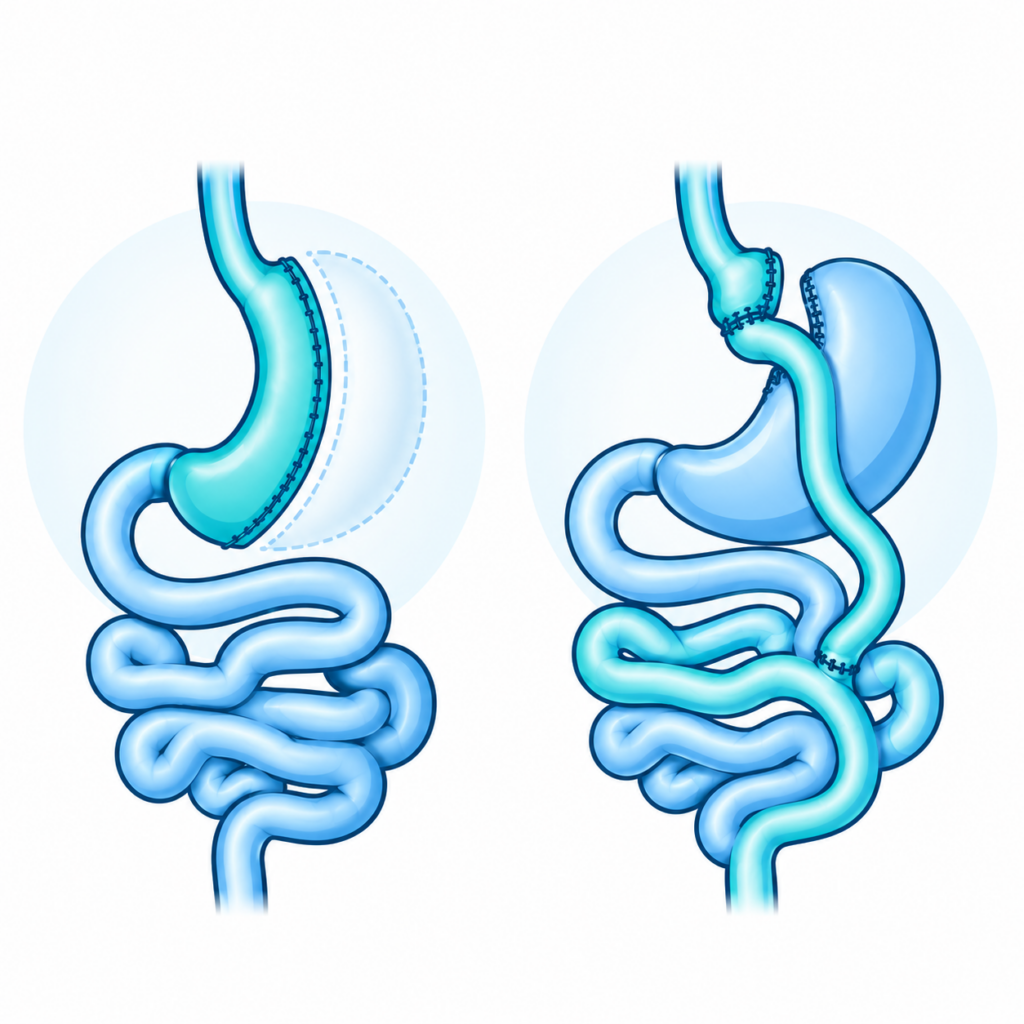
The decision is made after a complete work-up and discussion with the patient as part of multidisciplinary care.
It is not about choosing the “most effective” operation in absolute terms, but the one best suited to the patient’s situation.
Frequently asked questions:
According to current SMOB recommendations, bariatric surgery may be considered in adults from a body mass index of 35 kg/m² when the other necessary conditions are met.
In certain specific metabolic situations, particularly in some patients with inadequately controlled type 2 diabetes and a BMI between 30 and 35 kg/m², metabolic surgery may be discussed under specific conditions and within an interdisciplinary framework.
Adequate weight-loss care is part of the usual conditions for adults, in the absence of a sufficient and lasting result despite this treatment.
Yes. Type 2 diabetes, high blood pressure, sleep apnea, and other associated conditions are part of the overall evaluation and can influence the treatment strategy.
Meeting the criteria means surgery can be considered, but it does not automatically determine the procedure. Choosing the technique requires an individualized evaluation.
SMOB recommendations call for a commitment to long-term bariatric follow-up. This follow-up is an integral part of the treatment.
Considering obesity surgery?
Every situation is different. The consultation allows your history, health status, and expectations to be assessed, and the different treatment options to be discussed.
The goal is to determine, together with you, the strategy best suited to your situation.