
PROCTOLOGY
Hemorrhoids
Understanding hemorrhoidal disease and choosing the right treatment
Hemorrhoids are normal anatomical structures of the anal canal.
We speak of hemorrhoidal disease when they become responsible for symptoms such as bleeding, prolapse, discomfort or, in some situations, pain.
Treatment depends on the type of hemorrhoids, their severity and above all the symptoms they cause.
Simple measures may be enough in some situations. In others, an instrumental or surgical treatment may be proposed.
What are hemorrhoids?
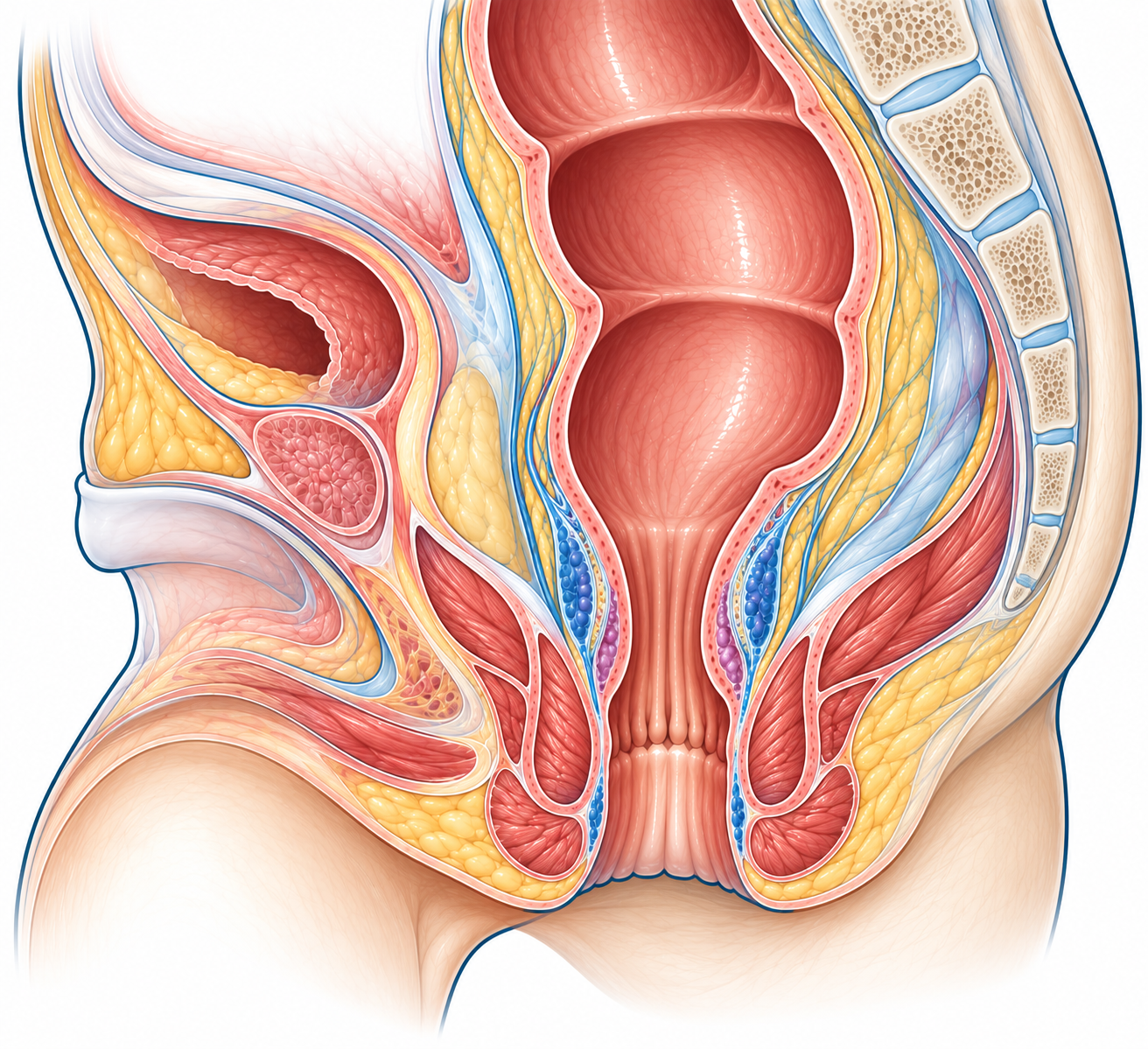
Normal anatomical structures
Contrary to a common belief, everyone has hemorrhoids.
They are vascular cushions located in the anal canal that participate in its normal function.
Two main types are distinguished:
- internal hemorrhoids, located in the upper part of the anal canal
- external hemorrhoidal manifestations, located under the skin around the anal opening
Their mere presence does not therefore constitute a disease.
We speak of hemorrhoidal disease when these structures become responsible for symptoms.
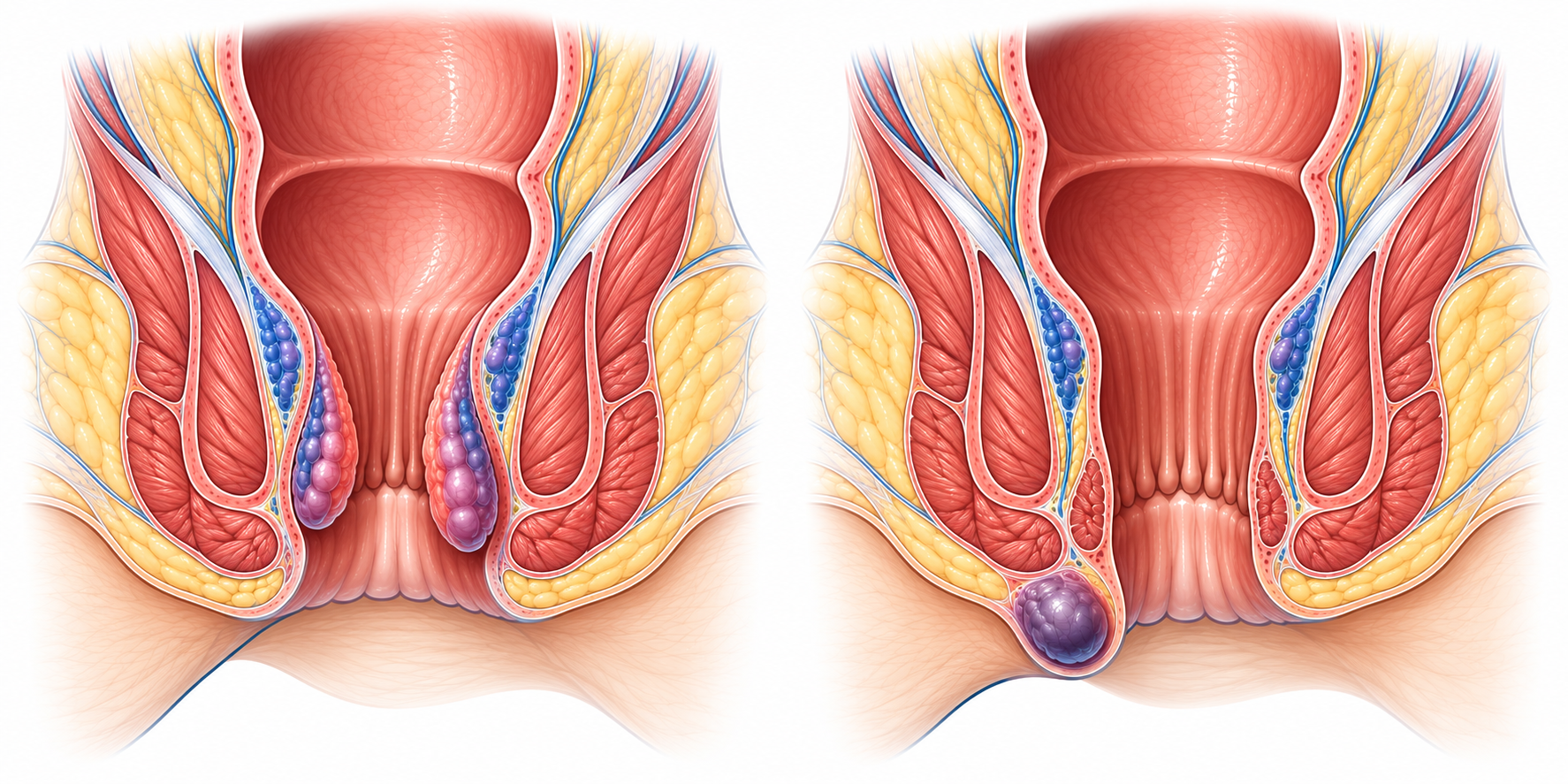
Internal and external hemorrhoids: what is the difference?
Two situations that should not be confused
Internal hemorrhoids develop at the level of the internal hemorrhoidal cushions.
They can notably cause bleeding or gradually descend within the anal canal and become prolapsed.
External manifestations are different.
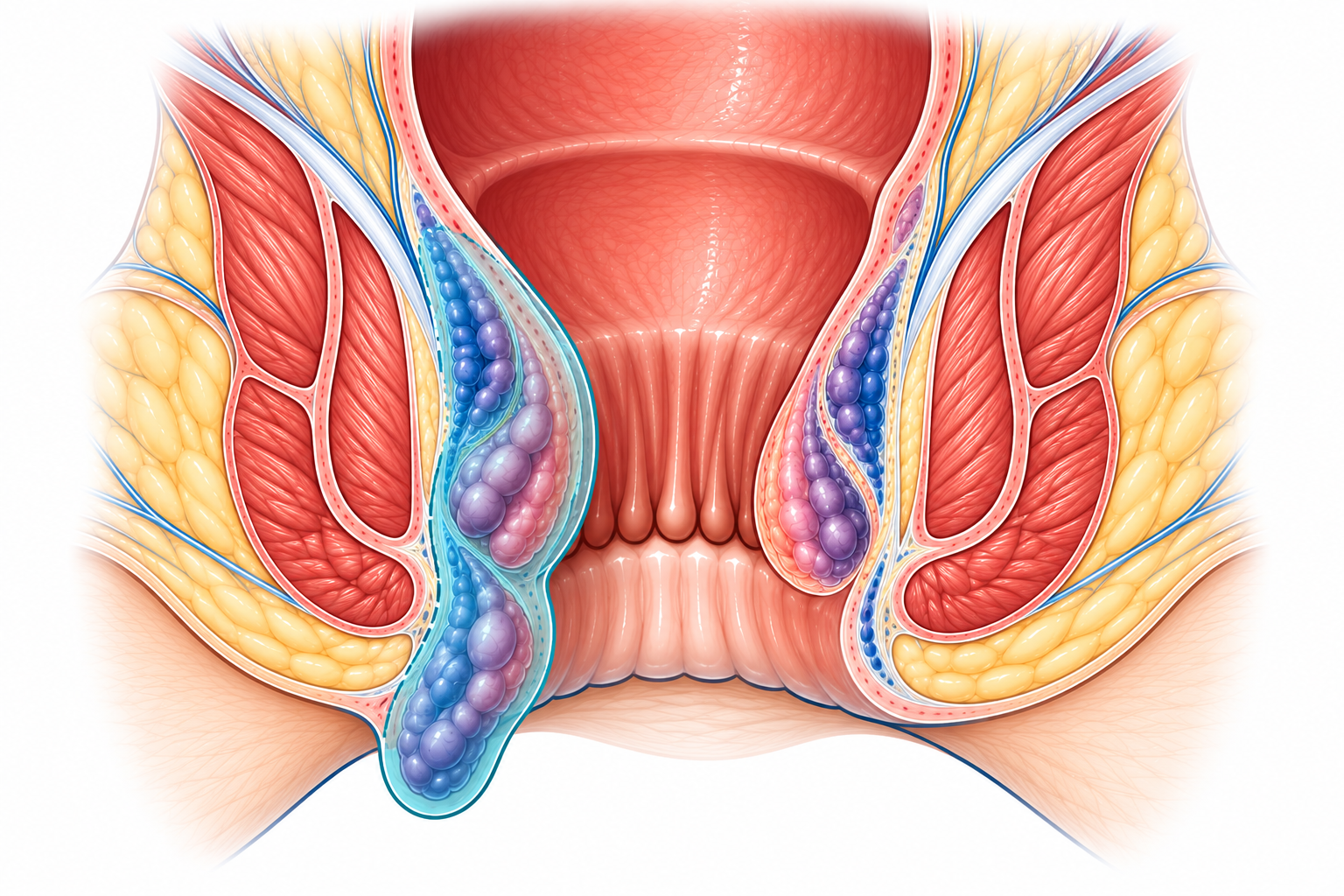
An external hemorrhoidal thrombosis corresponds in particular to the acute formation of a clot in an external hemorrhoidal plexus and can cause a sudden, painful swelling.
Treatment therefore depends first on the problem actually present.
What are the symptoms?
Variable manifestations
Internal hemorrhoidal disease can notably cause:
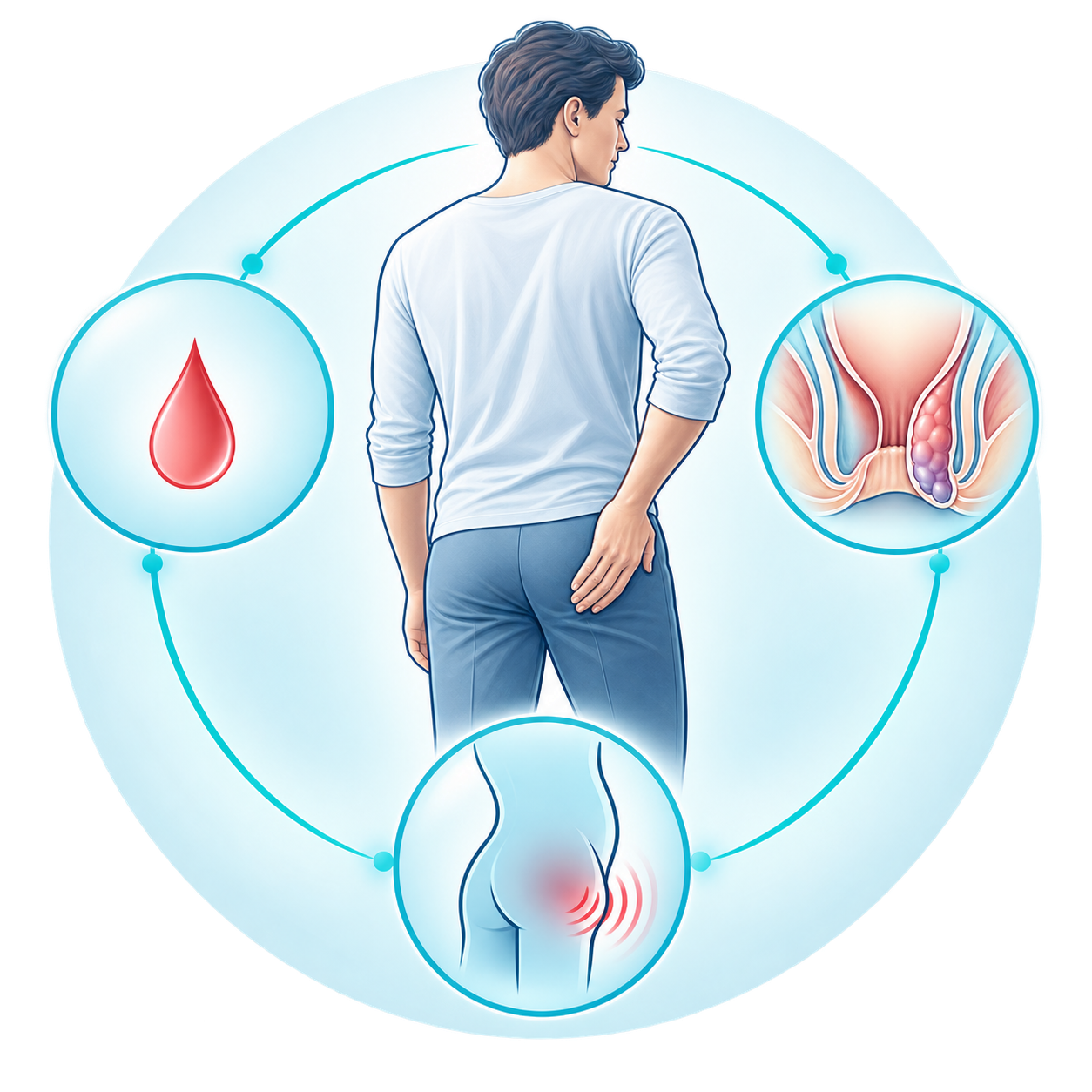
- bleeding during defecation
- prolapse or a sensation of descending tissue
- local discomfort
- discharge or hygiene difficulties in some situations
Significant anal pain is not automatically due to internal hemorrhoids.
Significant anal pain can also be related to an anal fissure.
An external thrombosis, on the other hand, can be particularly painful.
Any anal bleeding should not automatically be attributed to hemorrhoids.
Depending on age, symptoms and clinical context, further investigations may be necessary to exclude another cause.
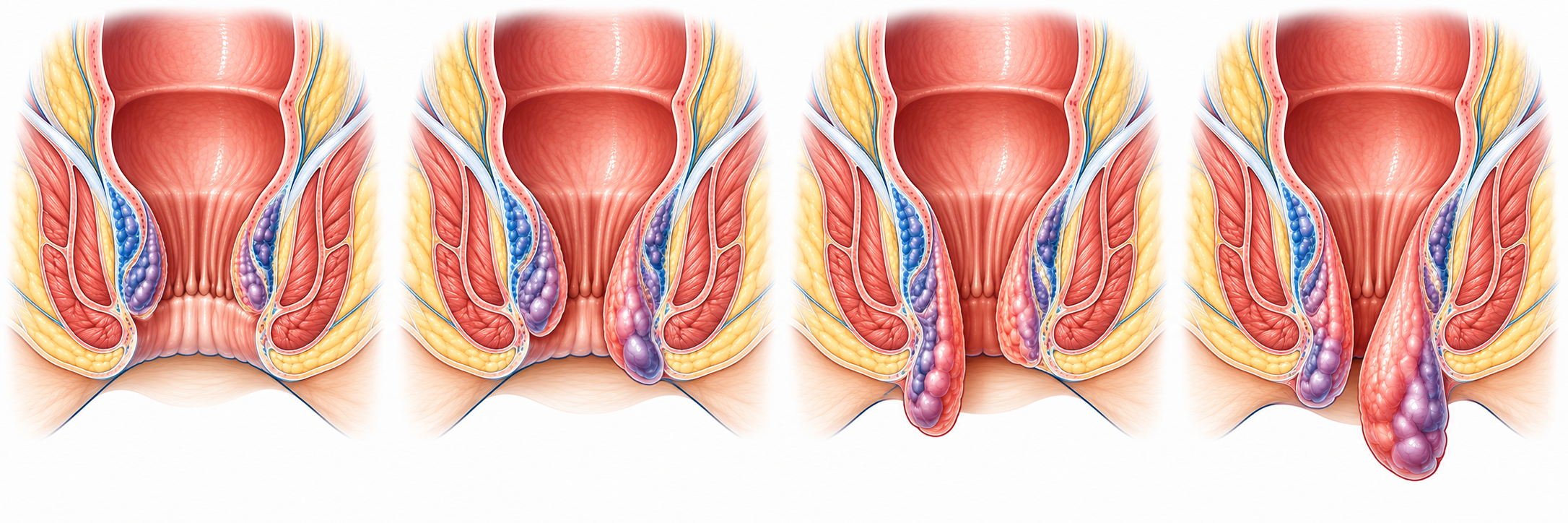
The different degrees of prolapse
The extent of prolapse contributes to the choice of treatment
Internal hemorrhoids can be classified according to their degree of prolapse.
In simplified terms:
Grade I — The hemorrhoids remain inside the anal canal.
Grade II — They may protrude during defecation and then reduce spontaneously.
Grade III — The prolapse may require manual reduction.
Grade IV — The prolapse remains permanently outside and is no longer reducible in the usual way.
This classification is useful, but it is not sufficient on its own to choose a treatment.
The severity of symptoms, the external component and the patient’s expectations must also be taken into account.
How is the diagnosis made?
A targeted proctological examination
The diagnosis is based first on the clinical history and examination.
Depending on the situation, the evaluation may include:
- inspection of the anal region
- a rectal examination
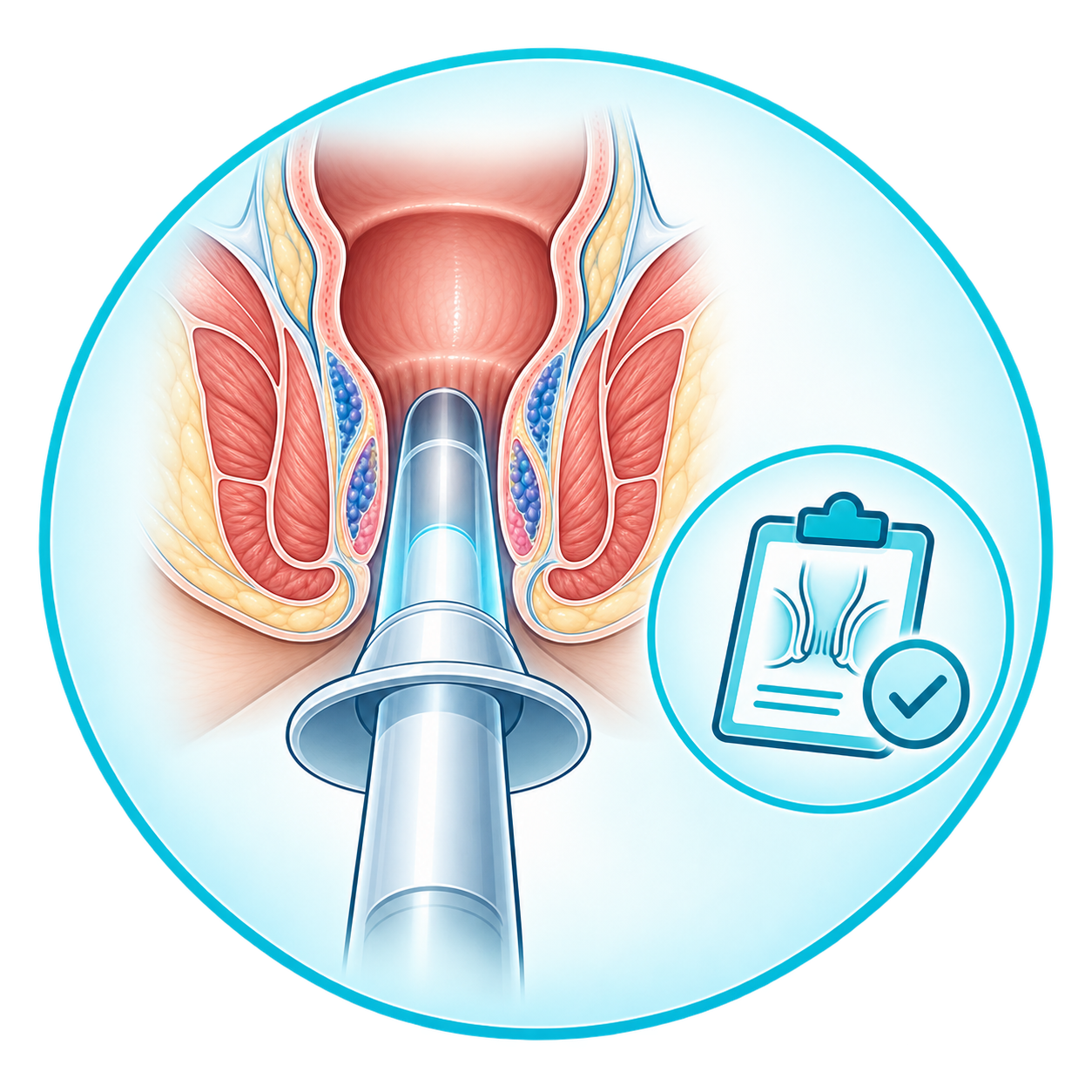
- anoscopy or proctoscopy
The goal is to precisely determine the origin of the symptoms and look for other conditions that might explain them.
A colonoscopy is not systematically necessary to diagnose hemorrhoids.
It may nonetheless be indicated in certain situations, particularly in the presence of bleeding, depending on age, risk factors and clinical context.
Treatment often begins without surgery
Regulating bowel transit and reducing contributing factors
When symptoms are moderate, initial treatment is often based on conservative measures.
The goal is notably to achieve stools that are easy to pass and to reduce straining.
Depending on the situation, measures may include:
- a diet providing sufficient fiber
- adequate hydration
- correction of constipation
- limiting prolonged straining
- symptomatic treatments when indicated
These measures can be useful even when an instrumental or surgical treatment subsequently becomes necessary.

Instrumental treatments
Treating certain internal hemorrhoids without excisional surgery
When symptoms persist despite conservative measures, certain treatments can be performed depending on the type of hemorrhoids.
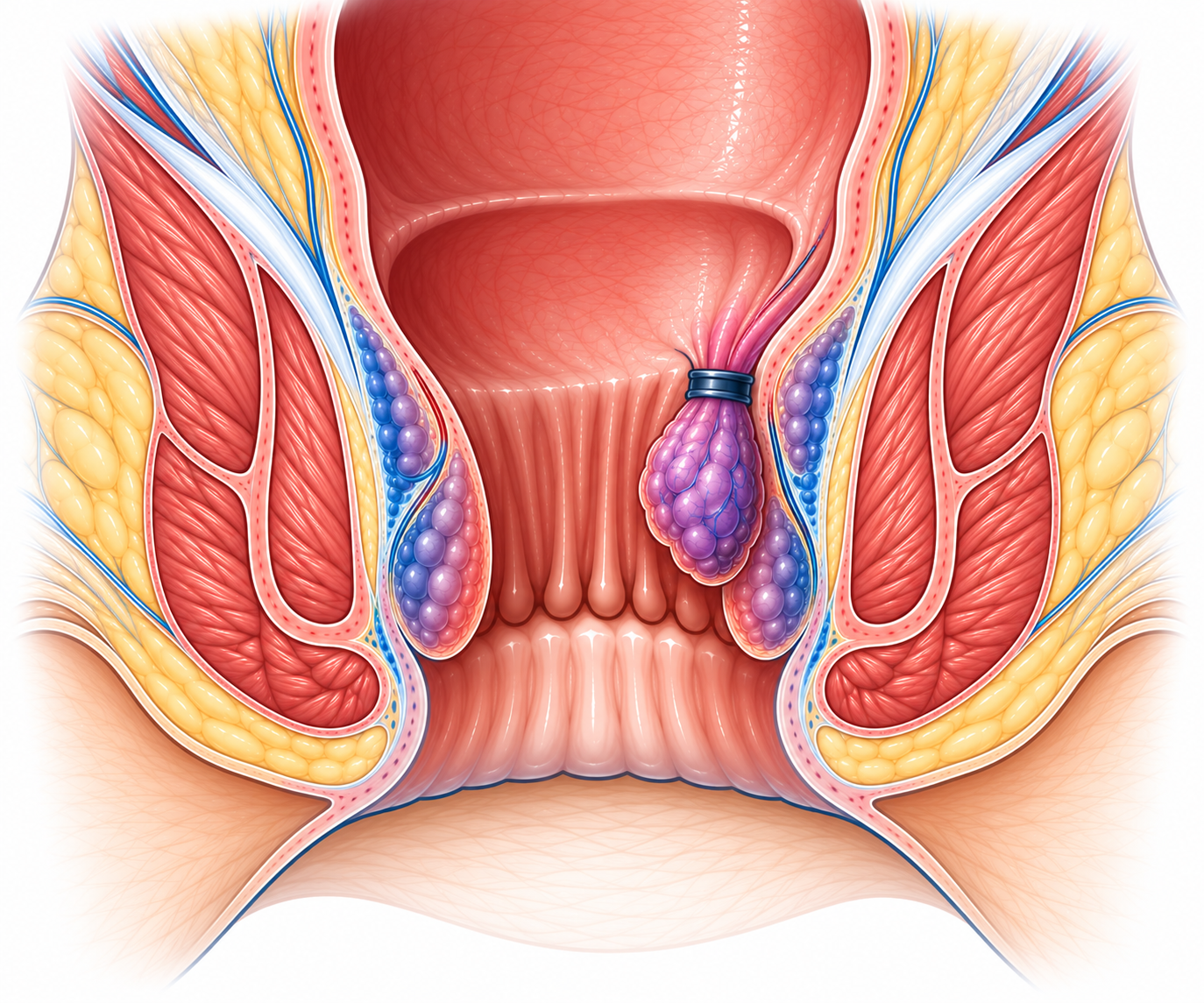
Elastic band ligation is one of the techniques commonly used for certain symptomatic internal hemorrhoids.
A small elastic band is placed at the base of the internal hemorrhoidal tissue to interrupt its blood supply.
The treated tissue then gradually regresses.
Other instrumental techniques also exist.
The choice depends notably on the grade, the dominant symptom and the hemorrhoidal anatomy.
HAL-RAR: treating the arterial supply and the prolapse
An approach without systematic excision of the hemorrhoidal cushions
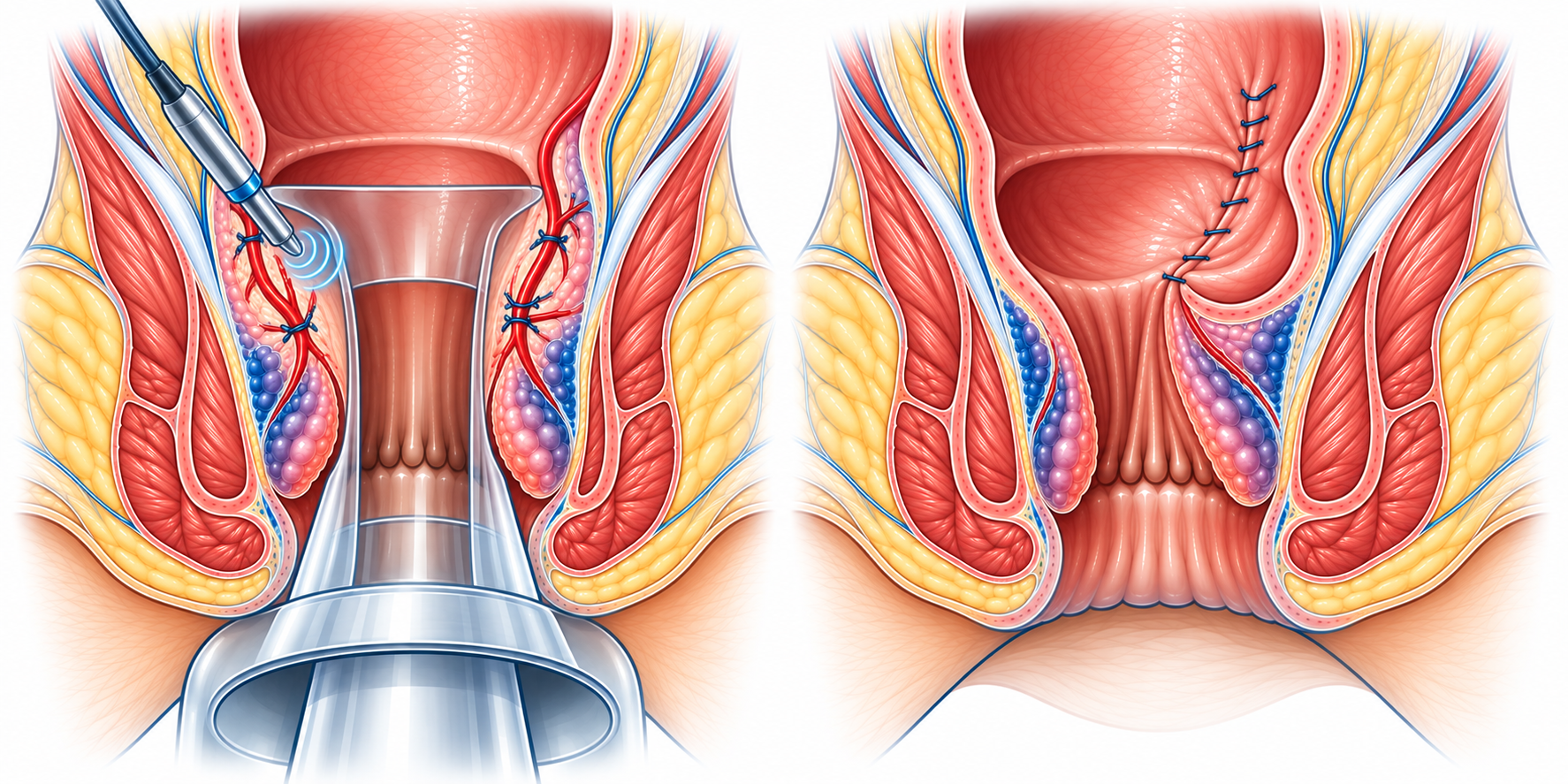
HAL-RAR combines two complementary principles.
HAL — Hemorrhoidal Artery Ligation
The first step consists of identifying the arterial branches contributing to the blood supply of the hemorrhoidal tissue and then ligating them via a transanal approach.
Depending on the technique used, their localization can be assisted by a Doppler signal.
The ligation aims to reduce arterial inflow into the hemorrhoidal cushions.
RAR — Recto-Anal Repair
When the disease involves significant mucosal prolapse, a mucopexy may be added.
Sutures then gradually reposition the prolapsed tissue toward its anatomical position.
The principle of HAL-RAR is therefore different from a conventional hemorrhoidectomy:
the aim is to reduce the arterial supply and correct the prolapse rather than systematically excise the hemorrhoidal cushions.
What is the benefit of HAL-RAR?
A technique that avoids conventional hemorrhoidal excision
The absence of systematic excision is one of the distinctive features of the technique.
The ligation is performed in an internal zone and the mucopexy aims to reposition the tissues.
Compared with an excisional hemorrhoidectomy, this approach may be associated with less postoperative pain in some studies.
This difference must, however, be weighed against long-term effectiveness.
Available data show that recurrence, particularly of the prolapse, can be more frequent after arterial ligation than after an excisional hemorrhoidectomy.
HAL-RAR is therefore not automatically the best treatment for all hemorrhoids.
The goal is to choose the technique suited to the type of hemorrhoidal disease rather than applying the same operation to all patients.
Is Doppler essential to HAL-RAR?
A more nuanced topic than it appears
Historically, HAL was developed with Doppler guidance to identify the arterial branches before their ligation.
Doppler is still used in certain techniques and with certain devices.
However, recent studies have compared procedures performed with and without Doppler guidance.
They have not convincingly demonstrated that Doppler systematically improves outcomes when ligation and mucopexy are correctly performed.
Mucopexy and correction of the prolapse appear to play a particularly important role in outcomes when the prolapse is the main problem.
It is therefore preferable to present HAL-RAR as a surgical principle, whose technical modalities can vary, rather than reducing the whole procedure to Doppler localization alone.
When should a hemorrhoidectomy be considered?
Excision remains important in certain situations
Excisional hemorrhoidectomy consists of surgically removing the selected pathological hemorrhoidal cushions.
It may notably be considered in certain advanced hemorrhoidal diseases or when a significant external component also needs to be treated.
It is generally associated with a more painful initial recovery than certain non-excisional techniques.
On the other hand, it remains a particularly effective technique with a low risk of recurrence in appropriate indications.
The choice must therefore weigh:
- the anatomy of the disease
- the extent of the prolapse
- the internal and external component
- the symptoms
- treatments already performed
- the advantages and limitations of the different techniques
HAL-RAR or hemorrhoidectomy?
Two different approaches
It is not a matter of determining which procedure is ” better ” in absolute terms.
HAL-RAR
The principle consists of preserving the tissue, reducing its arterial supply and correcting the prolapse by mucopexy when necessary.
It may offer a less painful recovery in certain situations.
A recurrence or residual prolapse may nonetheless be more frequent than after an excisional hemorrhoidectomy.
Hemorrhoidectomy
It directly removes the selected pathological hemorrhoidal tissue.
The postoperative period may be more painful, but it remains particularly effective for certain significant hemorrhoidal diseases, notably when a significant external component is present.
The choice is individualized
The examination helps determine the technique most consistent with the anatomy and symptoms.
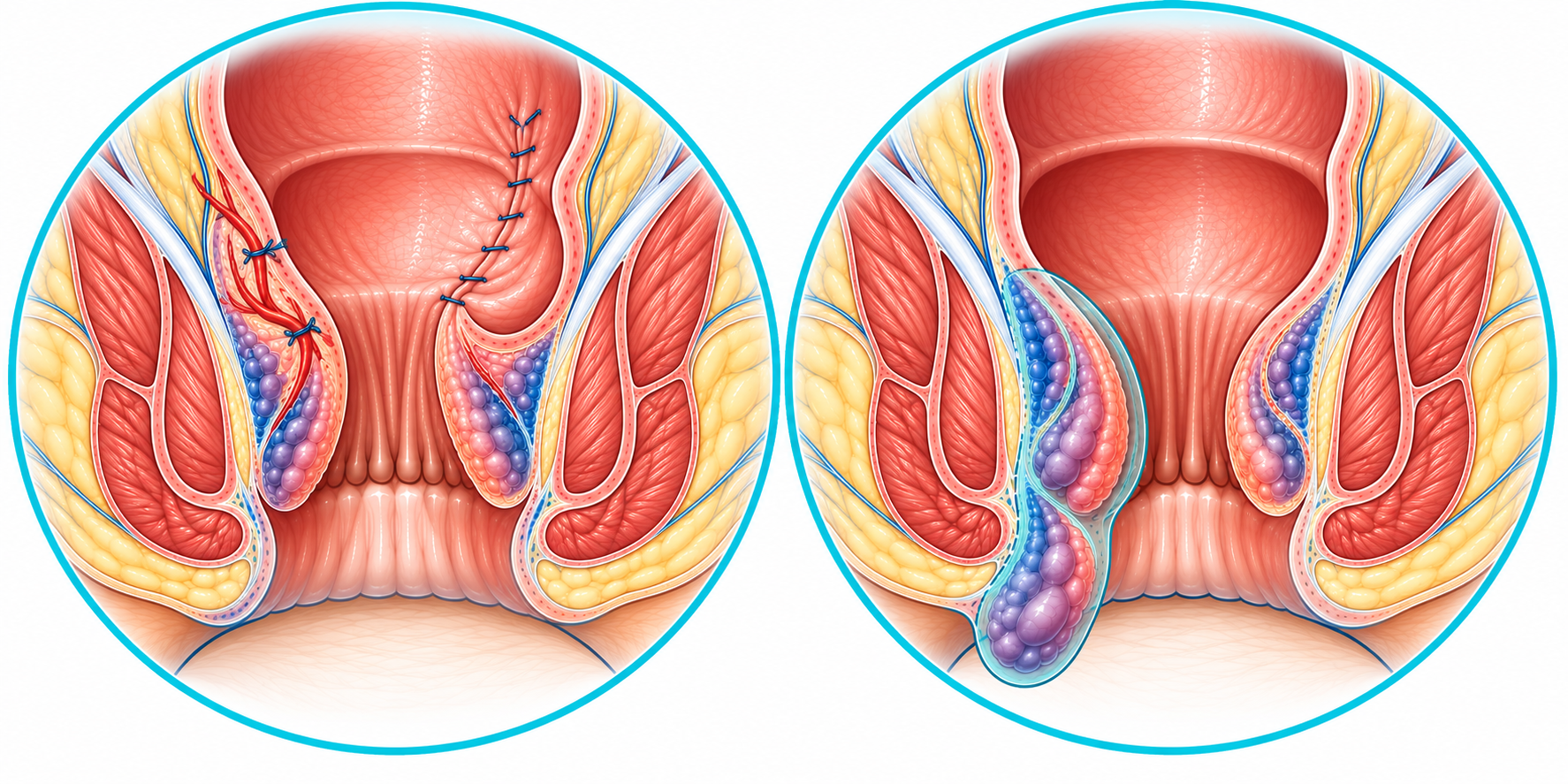
And what about external hemorrhoidal thrombosis?
A particular situation
External hemorrhoidal thrombosis typically presents as the rapid onset of a painful swelling at the anal margin.
Its course and treatment differ from those of chronic internal hemorrhoidal prolapse.
In many situations, conservative treatment allows for gradual improvement.
In certain particularly painful thromboses seen early, local surgical treatment may be discussed.
The decision depends notably on the intensity of the symptoms, their duration and the clinical examination.
After a procedure
A gradual recovery
The aftermath depends strongly on the technique used.
Discomfort, pain, minor blood loss or a sense of urgency may occur after certain treatments.
The priority is notably to maintain soft stools in order to limit straining.
Resumption of activities occurs gradually depending on the procedure and progress.
After an excisional hemorrhoidectomy, recovery is generally longer and pain can be greater than after certain non-excisional techniques.

When to consult?
A consultation is particularly useful in case of:
- repeated bleeding
- prolapsus
- persistent discomfort
- painful anal swelling
- recurring symptoms despite simple measures
- uncertainty about the origin of the symptoms
Digestive bleeding should not be automatically attributed to hemorrhoids without appropriate evaluation.
Care tailored to your hemorrhoidal disease
Not all hemorrhoids require the same procedure
The goal of the consultation is to precisely identify the cause of the symptoms.
The examination notably helps determine:
- whether hemorrhoidal disease is actually present
- whether it is mainly internal or external
- the extent of the prolapse
- the dominant symptom
- treatments already performed
- whether a conservative, instrumental or surgical treatment is indicated
- and, when a procedure is being considered, which technique is most appropriate
Depending on the situation, different options can be discussed, including elastic band ligation, HAL-RAR or hemorrhoidectomy.
Dr Pierre Fournier
General and Visceral Surgery
[Actual photo of Dr. Fournier — to be inserted once available]
Frequently Asked Questions
Yes. The hemorrhoidal cushions are part of normal anatomy. We speak of hemorrhoidal disease when they become symptomatic.
Yes, particularly internal hemorrhoids. However, bleeding should not automatically be attributed to hemorrhoids.
No. Internal hemorrhoids can cause bleeding or prolapse without significant pain. Acute pain can notably occur in the case of external thrombosis or be related to another proctological condition.
No. Its indication depends on the context, notably age, symptoms, risk factors and the need to exclude another origin of the bleeding.
HAL-RAR combines the ligation of hemorrhoidal arterial branches and, when a prolapse is present, a mucopexy intended to reposition the tissue.
It can be used to locate the arterial branches before their ligation. Recent data, however, do not clearly demonstrate that Doppler guidance systematically improves the outcomes of all HAL-RAR procedures.
The principle is different from an excisional hemorrhoidectomy. The technique aims mainly to reduce the arterial supply and correct the prolapse without systematic excision of the cushions.
It may be associated with less pain than an excisional hemorrhoidectomy in some studies. Results, however, depend on the situation and the technique used.
No. Recurrence remains possible and may be more frequent than after an excisional hemorrhoidectomy in certain situations.
It may notably be indicated in certain advanced hemorrhoidal diseases or when a significant external component needs to be treated. The choice depends on the examination.
It is an instrumental treatment used for certain internal hemorrhoids, not an excisional hemorrhoidectomy.
Hemorrhoids are not cancer and do not turn into cancer. However, certain symptoms, particularly bleeding, can have other causes, which explains the importance of an appropriate diagnosis.
Bleeding, prolapse or anal discomfort?
A proctological consultation makes it possible to precisely determine the origin of the symptoms and the most appropriate treatment.
When treatment is necessary, the goal is to choose the approach that truly corresponds to the type of hemorrhoidal disease rather than systematically proposing the same technique.